
About this mission
This research mission explores how 2D materials can enable highly sensitive sensors and advanced electronic devices. Because every atom in a 2D material lies on the surface and is directly exposed to its environment, these materials are exceptionally responsive to external signals such as light, gases, temperature changes, biomolecules and mechanical stimuli.
Research area
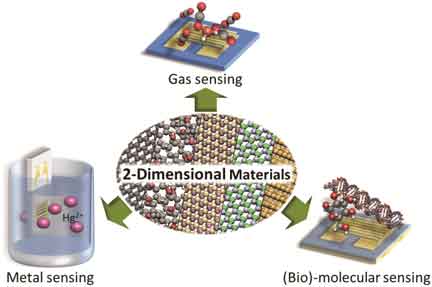
2D materials are extremely sensitive because every atom is sitting on the surface and therefore exposed to the environment. They can detect infrared/THz light, variations of temperature, gases, biomolecules at very low concentrations, or mechanical stimuli, making them ideal for sensors and detectors. For example, graphene gas sensors can pick up just a few molecules of toxic gases such as NO₂ and CO. MoS₂-based biosensors can detect DNA strands or proteins, enabling applications in wearable health monitoring and point-of-care diagnostics. Flexible pressure sensors based on 2D materials can also be integrated into wearable electronics.
Beyond sensing, 2D materials are also used in transistors, memory devices, flexible circuits and neuromorphic devices. Their integration with CMOS technologies could enable highly miniaturized, multifunctional sensor networks for healthcare, environmental monitoring and the Internet of Things.
Selected publications
The following publications highlight recent research achievements from our CDT research community working in this mission area.
- Nowakowski K., et al, Single-photon detection enabled by negative differential conductivity in moiré superlattices. Science 389, 644 (2025). In collaboration with ICFO in Barcelona, we designed a single-photon detector based on moiré superlattice in graphene and hexagonal boron nitride heterostructures. Tuning the electronic bands by twisting the layers relative to each other extends the sensitivity to wavelengths above 11 microns, and the system is operable at relatively high temperatures (20 kelvin). Because it is compatible with complementary metal-oxide-semiconductor processing, such material can be integrated with photonic circuits and CMOS technologies.
- Chen L., et al. Wearable Sensors for Breath Monitoring Based on Water-Based Hexagonal Boron Nitride Inks Made with Supramolecular Functionalization. Advanced Materials 36, 2312621 (2024). The University of Manchester team has developed a wearable and wireless impedance-based humidity sensor made with pyrene-functionalized hexagonal boron nitride (hBN) nanosheets, suitable for health monitoring applications. This new hBN-based sensor is able to monitor the whole breathing cycle process of exhaling and inhaling, hence enabling to record in real-time the subtlest changes of respiratory signals associated with different daily activities as well as various symptoms of flu, without requiring any direct contact with the individual.
- Smith K., et al. Modeling Graphene–Polymer Heterostructure MEMS Membranes with the Föppl–von Kármán Equations. ACS Appl. Mater. Interfaces 15, 9853 (2023). A powerful new tool has been developed for the design and development of graphene-based NEMS devices for applications in ultra-sensitive mass detection, capacitive pressure sensors and microphones.