
About this mission
This research mission focuses on identifying and engineering new classes of materials with quantum properties that can be harnessed for advanced electronic and quantum information technologies.
Research area
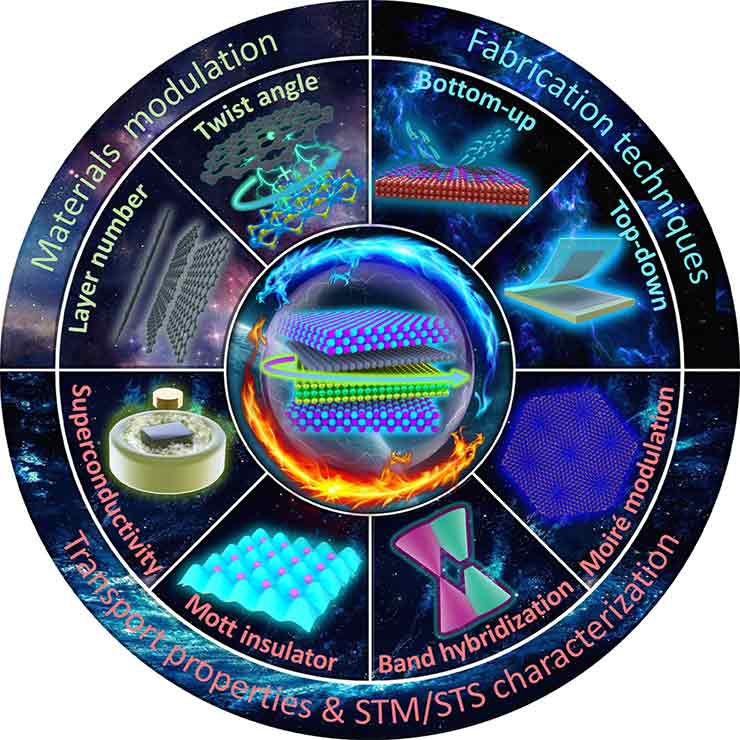
Atomically thin materials behave in different ways compared to familiar macroscopic crystals. By stacking them together in Lego-like fashion we can create “designer” quantum materials with a new set of properties, not present in the individual layers.
A key approach in this area is twistronics, where electronic properties are controlled by twisting adjacent 2D layers at specific angles. This has led to discoveries such as magic-angle graphene with unconventional superconductivity and tunable ferroelectrics. The search for 2D magnets (e.g., CrI₃, Fe₃GeTe₂) enables spintronic applications, while atomically thin superconductors may lead to ultra-compact quantum circuits.
Research in this area underpins quantum computing, neuromorphic electronics, and ultra-sensitive sensors.
Selected publications
The following publications highlight recent research achievements from our CDT research community working in this mission area.
- Barrier, J. et al, One-dimensional proximity superconductivity in the quantum Hall regime, Nature 628, 741-745 (2024). This work demonstrated that domain walls in minimally twisted bilayer graphene provide extremely robust Josephson junctions, enabling proximity superconductivity in unusually high magnetic fields, corresponding to quantum Hall regime.
- Sarkar et al, Spin injection in graphene using ferromagnetic van der Waals contacts of indium and cobalt, Nat. Electron. 8, 215-221 (2025). Demonstration of efficient spin injection in graphene spintronic devices using ferromagnetic van der Waals contacts without dielectric barriers.
- Domaretskiy et al, Proximity screening greatly enhances electronic quality of graphene, Nature 644, 646-651 (2025). Record electronic quality of graphene has been achieved using so called proximity gates (metallic gates placed at 1nm distance from graphene). The resulting drastic decrease in charge inhomogeneity allows to study robust many-body phenomena and explore new quantum physics effects.
- Diaz-Nunez et al, Visualization of topological shear polaritons in gypsum thin films, Sci. Adv. 11, eadw3452 (2025). Demonstration that exfoliated low-symmetry crystals like gypsum enable shear phonon polaritons, revealing a topological transition with extreme light confinement and ultra-slow propagation, expanding opportunities for tunable, compact photonic devices.
- McHugh J., et al, Two-dimensional electrons at mirror and twistronic twin boundaries in van der Waals ferroelectrics. Nat. Commun. 15, 6838 (2024). A new type of 2D electron gas has been predicted to form at twin boundaries in multilayers of rhombohedral polytypes of transition metal dichalcogenides (such as 3R-MoS2).