
About this mission
This research mission explores how van der Waals and 2D materials can revolutionise the way we use light and heat in technology.
Research area
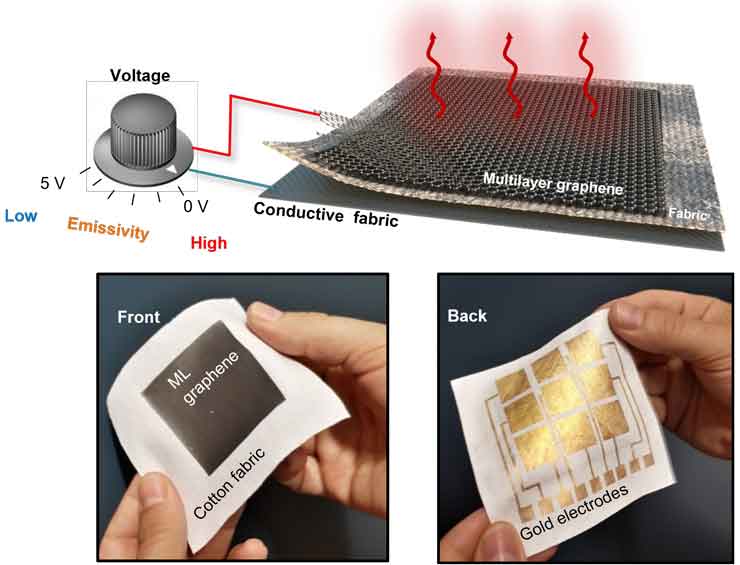
Many 2D semiconductors, such as transition metal dichalcogenides (TMDs), absorb light with exceptionally high efficiency. This makes them suitable for flexible solar cells and smart photodetectors, especially when combined with peculiar ferrolectric properties found in some TMD polytypes.
At the same time, electrons and holes injected into monolayers of materials such as MoS2 can efficiently emit light, offering LED functionality compatible with a simultaneous transistor operation. Heterostructures comprising different 2D materials, enable researchers to tailor spectral characteristics and achieve high-performance at low power consumption. This can be combined with the high thermal conductivity of graphene and hBN, which are excellent candidates for heat spreading, thermal barriers and phonon engineering, contributing to thermal management in electronic and photonic devices.
Applications of this research range from smart windows and adaptive displays to tunable LEDs, photodetectors and thermoelectric materials for energy harvesting.
Selected publications
The following publications highlight recent research achievements from our CDT research community working in this mission area.
- Gao, Y. et al, Tunnel junctions based on interfacial two-dimensional ferroelectrics, Nat. Commun. 15, 4449 (2024).; Weston A., et al, Interfacial ferroelectricity in marginally twisted 2D semiconductors. Nat. Nanotech. 17, 390 (2022). Demonstration that assembled bilayers of transition metal dichalcogenides can exhibit room-temperature ferroelectricity reversable by sliding, with ambipolar switching and polarization reversal governed by domain structures and dislocations. This enables novel, tunable ferroelectric tunnelling junctions for advanced optoelectronic applications.
- Xia, T., et al. Graphenization of graphene oxide films for strongly anisotropic thermal conduction and high electromagnetic interference shielding. Carbon 215, 118496 (2023). It has been demonstrated that annealing of reduced electrochemical graphene oxide (REGO) printed into laminated films produces a nearly intact graphene laminate with excellent heat spreading properties and capability of electromagnetic shielding.
- Peng, Z, et al. Fully printed memristors made with MoS2 and graphene water-based inks. Materials Horizons 11, 1344 (2023). Fully inkjet printed MoS2-based resistive switching memory was produced, where graphene is used as top electrode and silver as bottom electrode. When printed on silicon, such a memory shows low SET/RESET voltage, short switching times (less than 0.1 s) and switching ratios of 103–105, comparable or superior to the performance obtained in devices with both printed silver electrodes on rigid substrates.
- Wang Y., et al, P-type electrical contacts for 2D transition-metal dichalcogenides. Nature 610, 61-66 (2022). High-performance transistors have been developed based on 2D TMDs with van der Waals contacts with high-work-function metals (Pd, Pt) enabling low-resistance, high-mobility devices and efficient ultrathin photovoltaic cells.