
About this mission
This research mission investigates how molecules and ions behave when confined between layers of 2D materials, and how this confinement can be harnessed to create new properties. It also explores innovative synthesis and growth techniques to produce high-quality, defect-engineered 2D materials and heterostructures for advanced applications.
Research area
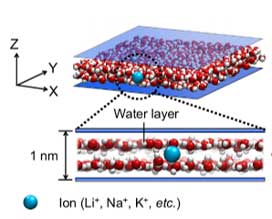
When molecules or ions are squeezed between layers of 2D materials, they both change properties of van der Waals compounds and behave in surprising ways themselves. This “nano-confinement” can speed up chemical reactions, change how ions move, make water move at ultrahigh speed, or even stabilise unusual phases of matter. Strong confinement leads to emergent phenomena such as new phase transitions, unusual ion transport or selective molecular adsorption. Controlled confinement can also be used to catalyse chemical reactions at reduced energy costs.
On the synthesis side, innovative techniques such as chemical vapor deposition (CVD), molecular beam epitaxy or solution-based growth, are being refined to produce large-area, defect-engineered 2D materials and their heterostructures. At the same time, intercalation by ions can change optical appearance of materials, leading to adaptive optics systems. This area of research combines fundamental science with scalable manufacturing strategies for practical technologies.
Selected publications
The following publications highlight recent research achievements from our CDT research community working in this mission area.
- Wang, R. et al, In-plane dielectric constant and conductivity of confined water, accepted in Science (2025). Demonstrated that water confined to a few nanometers between atomically flat surfaces exhibits giant in-plane dielectric constants and superionic-like conductivity due to disordered hydrogen bonding, revealing unique electrical behaviour distinct from bulk water.
- Tong, J. et al, Crystallization of molecular layers produced under confinement onto a surface, Nat. Commun. 15, 2015 (2024). A gas-blowing crystallization method enables the formation of molecular layered crystals, as thin as a monolayer on surfaces, selectively producing van der Waals polymorphs and unlocking new opportunities for confined materials chemistry.
- Yoon, S. I. et al, Pressure enabled organic reactions via confinement between layers of 2D materials, Sci. Adv. 10, eadp9804(2024). Reactants confined between atomically thin graphene or boron nitride layers experience extremely high pressures (~7 GPa), enabling solvent-free organic reactions and polymerization that are otherwise inaccessible under standard conditions.
- Yang, Q. et al, Capillary condensation under atomic-scale confinement, Nature 588, 250-253 (2020). Using atomically thin capillaries built from 2D crystals, it was found that the Kelvin equation (that describes bulk water in porous media) surprisingly remains valid for water condensation down to monolayer confinement, with deviations explained by elastic deformation of the capillary walls.
- Ergoktas S. Multispectral graphene-based electro-optical surfaces with reversible tunability from visible to microwave wavelengths, Nature Photonics 15, 493 (2021). Non-volatile and reversible tunability of optical response of multilayer graphene was achieved by electro-intercalation of lithium. The unique colour changing capability, together with area-selective intercalation, inspires the fabrication of new multispectral devices, including display devices and electro-optical camouflage coating, offering realistic approaches for programmable smart optical surfaces.